Emissions of greenhouse gases (GHGs) and other pollutants are a pressing concern for environmental and human health. Despite recent declines in the U.S., the global level of emissions remains at historic levels, leading to alarm among public health advocates and climate change activists alike. [1]
Although there are many factors behind these historically high emissions levels, none is as significant as transportation. In the U.S., the transportation sector accounts for 29% of all GHG emissions, ahead of even electricity generation and industry. [2] These emissions are highly concentrated in urban areas. According to the United Nations, 60% of GHGs come from cities, where cars and other modes of transportation relying on Internal Combustion Engines (ICE) are especially prominent. [3]
This makes urban transportation a strategic target for reducing emissions and curbing their impact on the environment and public health. The good news is that more than 10,000 cities have already committed to reducing carbon emissions by 2050. [4] Still, if history is any indication, curbing transportation emissions is easier said than done. Ultimately, city planners, transportation agencies, and many other stakeholders must come together with a strategic plan.
What will it take to reduce emissions from transportation, and just how important is this task? In this article, we’ll explore:
The cost of urban emissions
Shifting the urban transportation paradigm
Picturing the future with big data
The Cost of Urban Emission
Emissions are more than a nuisance — they exact a heavy toll on the global economy. In the U.S. alone, pollution accounts for around 5% of the nation’s gross domestic product in damages each year, or $1.3 trillion in 2023. More than mere dollars and cents, however, the costs of pollution are particularly prominent in terms of public and environmental health. [5]
Damaging Public Health
By any estimation, pollution is a serious public health concern. According to one in-depth study, fine particulate matter from numerous toxic pollutants contributes to between 100,000 and 200,000 deaths in the U.S. each year. The transportation sector is responsible for the second-largest number of these deaths, behind only industrial and commercial activity. [6]
No matter who is involved, such a large number of deaths is tragic. Yet, the tragedy is made worse by inequity, as pollution disproportionately impacts already vulnerable Americans. Children, pregnant people, older adults, people of color, and those living in poverty are among those most at risk for adverse outcomes from pollution. [7]
Transportation emissions are a primary source of city smog impacting residents’ health.
Accelerated Climate Change
GHG emissions are the single largest contributor to climate change since the mid-20th century. [8] Research has connected emissions from human activity to a host of environmental events, including temperature extremes, surges in precipitation, more frequent droughts and wildfires, and more devastating weather patterns.
The risk of these events continues to grow, and the Intergovernmental Panel on Climate Change (IPCC) warns of serious peril for major ecosystems if global temperatures aren’t brought under control. If global averages reach temperatures of at least 1.5 degrees Celsius above pre-industrial levels, the effect on human, plant, and animal life may be irreversible, even catastrophic. [9]
Shifting the Urban Transportation Paradigm
In light of such devastating consequences, reducing carbon emissions is becoming a top priority for many involved in public policy and planning. Urban transportation represents an important target for these changes, as small adjustments in this sector could have an outsized impact on reducing pollution.
Realizing these outcomes requires three critical shifts in how we approach transportation in urban areas.
Move People First, Not Cars
The first and most important step in reducing urban transportation emissions is to shift away from a car-centric approach to transportation planning. The purpose of any type of transportation is to move people from one place to another, but many of our cities focus on moving cars.
Instead of merely building more and wider roads designed only for vehicles, planners can focus on building complete streets — ones that make room for all kinds of commuters, including pedestrians, bikers, and users of public transit. Centering multimodal transportation will help incentivize and enable more commuters to use these alternative methods.
Reducing reliance on household vehicles could have a substantial effect on urban emissions. According to the United Nations, each person who switches from cars to public transport could reduce their carbon emissions by up to 2.2 tons per year. [10] Another study shows that while public transit cuts GHG emissions by 58% compared to cars, cycling lowers them by 98% — meaning both offer substantial emissions reduction potential. [11]
The more transportation planners can leverage detailed data to inform their plans for new or updated roads, the more effective these changes can be. For instance, planners in Oregon’s largest special park district, the Tualatin Hills Park & Recreation District, were able to use detailed origin-destination data to confirm the value and potential impact of installing a bike-pedestrian bridge to move more commuters over a busy highway — without adding more car traffic.
See what emissions reduction tactics your city needs most
Although it’s possible to reduce emissions and other urban transportation problems by shifting the focus away from vehicles, it’s not feasible to entirely eliminate the need for cars in our cities. Where they are still needed, then, it’s critical to accelerate the move toward electric vehicles (EVs) and away from gas-powered vehicles.
One recent study showed that adopting EVs would reduce carbon emissions significantly in every state. In states like Washington or Vermont, which already rely on clean electricity sources, EV usage could reduce pollution from carbon emissions by more than 90%. Even in states like Kentucky and West Virginia, where electricity generation relies heavily on fossil fuels, emissions would drop by over 30% with a full transition to EVs. [12]
With more federal support for the EV initiative than ever, now is an ideal time for cities to encourage drivers to increase fuel efficiency and electrify their driving. In addition to the National Electric Vehicle Infrastructure (NEVI) grant program introduced by the Bipartisan Infrastructure Law (BIL), massive federal tax credits are also available for EVs and chargers, and many cities and states are taking a step further by providing credits of their own or encouraging utility companies to create rebate programs and other incentives. Cities themselves can also leverage such programs to expand public charging installations and electrify public transit.
Public EV chargers in cities help overcome barriers to accelerated EV adoption.
Rethink City Planning
As essential as investments in electrification and multimodal transportation are to reducing carbon emissions, they aren’t sufficient solutions to the problem. Urban planners must think bigger, considering land use, transportation, operations, policy, and more in a comprehensive approach to emissions-reducing city planning.
With a holistic view, city planners can make progress by focusing on initiatives such as investing in green buildings, expanding renewable energy production, and improving waste management. [13] They can also consider the best ways to invest in tomorrow’s transportation infrastructure.
This requires thoughtfulness and intentionality. The BIL provides historic levels of funding for cities to upgrade their transportation infrastructure, but studies show that these investments could actually lead to increased emissions if not used properly. For instance, the Georgetown Climate Center recommends that planners focus on a “fix it first approach” of maintaining existing roads and investing in public transit, EVs, and other low-carbon options — rather than building more roads or expanding existing ones, which could induce demand and bring more pollution. [14]
Again, choosing the right updates and planning initiatives requires access to extensive data, both in terms of transportation patterns and existing urban emissions levels. Only when properly informed can planners choose initiatives that will result in successful emissions reductions. Traffic engineers and planners focusing on sustainability can explore tailored traffic engineering data solutions to support targeted studies and low-emission strategies.
Picturing the Future With Big Data
At every turn in the fight against carbon emissions, data is critical for making informed, effective decisions. In transportation, planners must have access to a wide range of emissions-related metrics, such as:
Truck traffic by vehicle class (light-, medium-, and heavy-duty)
As urbanization continues to transform U.S. cities, this data has never been more critical for the decision-making process. Big data providers like StreetLight are helping to fill data gaps that would otherwise prevent planners from understanding their city’s impact on the climate. That’s how the Twin Cities Metropolitan Council was able to share critical emissions data with local governments, equipping them with crucial insights for local planning, rather than generic national numbers.
The Southern Maine Planning and Development Commission took a similar approach, using big data to power urban planning that reduces emissions. In the video below, see how they measured statewide VMT to develop regional mitigation strategies.
Stanford. “Global carbon emissions from fossil fuels reached record high in 2023.” https://sustainability.stanford.edu/news/global-carbon-emissions-fossil-fuels-reached-record-high-2023
United States Environmental Protection Agency. “Fast Facts on Transportation Greenhouse Gas Emissions.” https://www.epa.gov/greenvehicles/fast-facts-transportation-greenhouse-gas-emissions
United Nations. “Generating power.” https://www.un.org/en/climatechange/climate-solutions/cities-pollution
United Nations. “Seven Ways Cities Can Take Climate Action.” https://unfccc.int/news/seven-ways-cities-can-take-climate-action#
Standford. “How much does air pollution cost the U.S.?” https://sustainability.stanford.edu/news/how-much-does-air-pollution-cost-us
Environmental Science and Technology Letters. “Reducing Mortality from Air Pollution in the United States by Targeting Specific Emission Sources.” https://pubs.acs.org/doi/10.1021/acs.estlett.0c00424
American Lung Association. “Who is Most Affected by Outdoor Air Pollution?” https://www.lung.org/clean-air/outdoors/who-is-at-risk
United States Environmental Protection Agency. “Climate Change Indicators: Greenhouse Gases.” https://www.epa.gov/climate-indicators/greenhouse-gases
Intergovernmental Panel on Climate Change. “Climate Change 2022: Impacts, Adaptation and Vulnerability.” https://www.ipcc.ch/report/ar6/wg2/
United Nations. “Your guide to climate action: Transport.” https://www.un.org/en/actnow/transport
ScienceDirect. “The climate change mitigation effects of daily active travel in cities.” https://www.sciencedirect.com/science/article/pii/S1361920921000687
Yale Climate Connections. “Electric vehicles reduce carbon pollution in all U.S. states.” https://yaleclimateconnections.org/2023/09/electric-vehicles-reduce-carbon-pollution-in-all-u-s-states/
National League of Cities. “The Top 5 Ways Cities Are Addressing Climate Change.” https://www.nlc.org/article/2022/04/22/the-top-5-ways-cities-are-addressing-climate-change/
Georgetown Climate Center. “Issue Brief: Estimating the Greenhouse Gas Impact of Federal Infrastructure Investments in the IIJA.” https://www.georgetownclimate.org/articles/federal-infrastructure-investment-analysis.html
See how StreetLight's transportation analytics can help you improve mobility outcomes
Explore the resources listed above and don’t hesitate to reach out if you have any questions. We’re committed to fostering a collaborative community of transportation professionals dedicated to building a better future for our cities and communities.
Sustainability may be a marketing buzzword, but the concept has never been more critical in transportation. As climate change continues to charge forward, shifting our behaviors, habits, and societal systems to preserve and pass on a healthy environment is one of the most pressing challenges of our time.
Rethinking how we get around is a crucial aspect of this challenge. The transportation sector is responsible for more greenhouse gases (GHGs) — a leading driver of climate change — than any other sector in the United States. [1] Small changes in this area, when multiplied by millions of people in major urban areas, could dramatically reduce emissions and create a more sustainable lifestyle for future generations.
For sustainability to be more than a mere buzzword, however, we must move past using it as a marketing term and find sustainable transportation solutions that can truly move the needle in the fight against climate change. In this article, we’ll cover six key ways to drive sustainability in transportation, including:
The data is clear: Over the full vehicle lifecycle, hybrid and electric vehicles (EVs) produce far lower levels of GHG emissions than gas-powered cars. This is true even when accounting for the varying sustainability of fuel sources used to produce electricity. According to data from the Alternative Fuels Center, the average hybrid vehicle produces 55% as much emissions over its life as a similar gas-powered vehicle. The typical electric vehicle, meanwhile, produces 22% as much emissions as a gas car. [2]
Harnessing these benefits at scale requires significant investment into electric and hybrid vehicle technologies. Altogether, EVs and hybrids represented 16% of U.S. light-duty vehicle sales in 2023 — a significant amount, but far from unseating gasoline as the primary source of fuel. [3]
Federal and state programs provide tax credits or other incentives to encourage EV adoption and EV charger installation, but more programs are needed to overcome consumer concerns about battery range and costs of ownership. Local governments can explore additional incentives and work with utility companies to support rebate programs for EV chargers and bolster the electrical grid to handle growing charging demands. Additionally private and public organizations must step up to lead the charge in electrifying fleets and offering public charging options. More research and investment in other alternative fuels, such as biofuels, propane, and natural gas, could also help cut into the market share of gasoline. [4]
A map of EV charging gaps in Massachusettes highlights where more charging infrastructure may still be needed to meet rising demand.
Invest in Public Transportation Infrastructure
Public transportation is a multi-faceted sustainable transportation solution. Not only does it reduce GHG emissions — by as much as two-thirds compared to private vehicles — but it also drives sustainability in more holistic ways. For instance, a stronger public transportation infrastructure provides more equitable access to jobs, education, and services, raising the standard of living for some of the most disadvantaged members of society. It also promotes a more active lifestyle and reduces communities’ exposure to pollutants, both of which can improve health outcomes across the board. [5]
Urban planners can use transportation data solutions to find ideal opportunities for enhancing public transportation, whether by adding more light rail or expanding bus routes. For instance, planners with TransLink in Vancouver, B.C. used data comparing commuter reliance on various modes of transportation to demonstrate the strength of existing bus ridership across the metro area. With such detailed data on various urban corridors, planners were able to make the case for greater investment in bus transportation throughout the region.
Support Active Transportation Modes
Active methods of transportation, such as biking and walking, also tackle the sustainability problem from multiple angles. Communities with higher levels of active transportation are happier and healthier, and biking and walking can drastically reduce emissions. Even choosing to ride a bike instead of driving once a day can reduce one person’s emissions by as much as 67%. [6]
However, far too few U.S. cities are designed with cyclists and pedestrians in mind. To see more commuters make these choices, planners must make streets safer and routes more direct for active modes of transportation. That means expanding bike lanes, adding sidewalks and crosswalks, and reducing the width of certain streets. Similarly, cities would benefit from development approaches that increase population density and support shorter commutes by placing essential services within biking and walking distance.
Once again, deciding on the best options for such changes requires an in-depth analysis of available traffic data. Understanding current traffic patterns can help planners pinpoint, for instance, where a road diet may help to divert or slow traffic and make room for a new bike lane. Or, as planners did in Portland, Oregon, cities can examine the data on average trip distance to find opportunities for adding safer active transportation options such as pedestrian bridges or strategic walking paths.
See what emissions reduction tactics your city needs most
Not every transportation improvement requires a major overhaul. Some sustainable transportation solutions are simple, especially with the technology and data available today. Smart traffic management systems leverage tools like signal timing, traffic monitoring systems, and automated speed enforcement to improve traffic flow and reduce pollution from congestion and extended travel times. By reducing both extreme speeds and heavy idling, transportation planners can help improve fuel efficiency and lessen overall pollution. [7] These simple tools can also decrease speeding and related accidents, making transportation more sustainable in other important ways. [8]
Transportation planners and agencies can use detailed traffic data to find the best opportunities for these types of transportation systems management solutions. For instance, higher traffic counts or average speeds at a specific intersection could warrant camera-enforced radar or improvements in signal timing methods.
Smart traffic signals like the one pictured above can offer a cost-effective way to reduce idling time at intersections, while improving safety and travel times.
Develop Sustainable Freight Transport Solutions
According to the EPA, large trucks are already the fastest-growing contributor to transportation emissions. On top of that, shipments of U.S. goods are expected to increase by 40% by 2040, pushing the growth of emissions from freight ahead of all other transportation categories over the next 15 years. [9] In other words, you can’t address the sustainability of transportation without considering the role of freight transport.
Transitioning more fleets to electric or alternative fuels could substantially increase sustainability in this sector, especially for delivery vehicles that travel fewer than 200 miles per day. [10] Additionally, a significant portion of freight emissions come from poor route planning and wasted miles — areas that can benefit from data analysis around metrics like trip length, travel time, and hours of delay. By making delivery routes more efficient, large companies can offset some of the impact of this growing portion of the transport sector.
Prioritize Sustainable Urban Planning
Cities account for between 60% and 80% of the world’s energy consumption and 75% of emissions, despite only occupying about 3% of its land. [11] Transportation may be one of the biggest contributors to urban emissions and energy usage, but it’s by no means the only one.
That said, transportation is linked to numerous other aspects of urban planning, and connecting transport and sustainability ultimately requires a broader approach to all aspects of city planning. For instance, transportation planners can think beyond the mechanics of roadways to consider how adding green spaces to urban corridors can enhance quality of life and improve air quality by adding more trees.
Likewise, urban planners must dive into transportation data using modern urban planning tools to understand how a new development would affect traffic patterns and potentially help or harm larger sustainable development goals. Clear data on the traffic volume in a given corridor, for example, may help planners decide whether a road diet will ease or exacerbate traffic and pollution.
What Is the Future of Sustainable Transportation?
Setting the stage for greener transport is a critical component of the environmental movement. Without sustainable transportation, it’s difficult to imagine a sustainable future.
The good news is that there are several ways to make the transport sector more sustainable. And with big data at the center, planners can ensure these efforts achieve their maximum impact by making informed decisions about which initiatives are most urgent for their region.
Big data platforms like StreetLight InSight® provide valuable, actionable data that planners can use to evaluate vehicle emissions and understand how infrastructure changes could transform their area. With access to detailed metrics on origin and destination, vehicle volume, speed, turning movements, and more, you can look at potential solutions from every angle, both in terms of safety and sustainability.
In the video below, you can see how transportation professionals in Maine used these kinds of metrics to measure regional transportation emissions and equip cities and counties with data to inform local emissions reduction efforts.
To learn more about StreetLight’s methodology for measuring GHG emissions, and how StreetLight InSight® can help you capture this key data, check out our recent white paper.
U.S. Environmental Protection Agency. “Fast Facts on Transportation Greenhouse Gas Emissions.” https://www.epa.gov/greenvehicles/fast-facts-transportation-greenhouse-gas-emissions
Alternative Fuels Data Center. “Emissions from Electric Vehicles.” https://afdc.energy.gov/vehicles/electric-emissions
U.S. Energy Information Administration. “Electric vehicles and hybrids surpass 16% of total 2023 U.S. light-duty vehicle sales.” https://www.eia.gov/todayinenergy/detail.php?id=61344
University of Minnesota Transportation Futures Project. “Alternative Fuels & Vehicle Electrification.” https://www.minnesotago.org/application/files/5614/6376/6119/AlternativeFuels.pdf
World Resources Institute. “3 Ways to Reimagine Public Transport for People and the Climate.” https://www.wri.org/insights/3-ways-reimagine-public-transport-people-and-climate
UCLA. “How Riding A Bike Benefits the Environment.” https://www.wri.org/insights/3-ways-reimagine-public-transport-people-and-climate
Northeast Ohio Areawide Coordinating Agency. “Impacts of Idling.” https://www.noaca.org/regional-planning/air-quality-planning/transportation-emissions/impacts-of-idling
U.S. Department of Transportation. “ITS Fast Facts.” https://www.its.dot.gov/resources/fastfacts.htm
U.S. Environmental Protection Agency. “Why Freight Matters to Supply Chain Sustainability.” https://www.epa.gov/smartway/why-freight-matters-supply-chain-sustainability
Alternative Fuels Data Center. “Electric Vehicles for Fleets.” https://afdc.energy.gov/vehicles/electric-fleets
United Nations Foundation. “5 Statistics on Why Urban Development Matters.” https://unfoundation.org/blog/post/5-statistics-on-why-sustainable-urban-development-matters/
Learn how you can use transportation data for emissions measurement, EV charger siting, and more
Explore the resources listed above and don’t hesitate to reach out if you have any questions. We’re committed to fostering a collaborative community of transportation professionals dedicated to building a better future for our cities and communities.
Electric vehicles (EVs) are a critical element of the fight against climate change. Compared to a typical gas-powered vehicle, the average EV produces less than half the amount of carbon pollution over its lifetime. [1] Even at today’s moderate levels of EV sales, electric cars are already reducing crude oil usage by 1.7 million barrels a day. [2]
Yet we have a long way to go to reach the tipping point, when EVs take over as the primary form of individual transportation. In the U.S., 10% of new vehicles registered in 2023 were electric, far from a majority. [3] Tipping the scales requires not only an increase in EV production, but a significant expansion of the nation’s EV charging infrastructure.
As of today, our systems are woefully underprepared for an EV-dominant future. What will it take to catch up? Although federal and state-level funding is essential, building an adequate charging infrastructure largely comes down to smart, data-driven planning.
In this article, we’ll explore what that looks like, covering the following:
How do EV charging stations work?
The current state of EV charging infrastructure
Optimizing charger placement in communities
Promoting sustainable energy sources
How Do EV Charging Stations Work?
Electric vehicle supply equipment (EVSE), as charging stations are commonly called, is fundamentally different from gas pumps. While both types of equipment are designed to refuel vehicles, EV charging stations are far less standardized than gas pumps.
EVSE comes in several different types, from basic (extremely slow) Level 1 chargers to high-speed, Level 3 DC fast chargers. Although the latter can recharge an empty car battery to 80% in less than an hour, most public EVSE consists of Level 2 chargers, which take anywhere from four to 10 hours to achieve a similar charge level. [4]
Not surprisingly, EV charging station costs vary widely based on type. You can plug into your home outlet for Level 1 charging, but it’ll cost anywhere from $1,000 for a basic home Level 2 charger to upwards of $50,000 for a commercial Level 3 charger. [5], [6]
Besides the cost of EV charging stations, planners must consider numerous other factors, including the connection type, interoperability with various vehicles, and the payment network of choice. All of these are critical factors in how to build EV charging station infrastructure.
The Current State of EV Infrastructure
In the U.S., the number of public and private EV charging stations has grown rapidly in recent years, thanks largely to available tax credits and incentives to help reduce upfront costs. However, the nation’s EV charging infrastructure has a long way to go to keep pace with near-term goals for vehicle electrification.
That’s especially true for public EVSE. Recent research by Stanford University sounded the alarm that relying on nighttime, home-based charging would put far too much demand on the electrical grid within the next decade. [7]
Currently, there are almost 10 times more home EV chargers than public ones, and that ratio needs to change quickly. [8] Data from the National Renewable Energy Laboratory (NREL) further supports the need for a massive uptick in public charging station installations. As of 2023, there were just over 168,000 public charging ports available in the U.S., but NREL research calls for nearly 1.2 million public ports to match EV demand by 2030.[9], [10]
A screenshot from StreetLight’s EV Dashboard visualizes the largest EV charging infrastructure gaps across Massachusetts, based on vehicle activity and existing charger locations.
It’s not just a numbers game, either. If electric vehicles are to become the norm, EV charging station infrastructure must be more accessible to everyone. That means charging equipment must become more interoperable with all types of EVs, stations must be available where people can conveniently use them, and EVSE must be reliable and easy to use.
Overall, reaching this level of accessibility requires more investment in both public and private (workplace) charging, along with a commitment to eradicating “charging deserts” in underserved communities. [11]
See what emissions reduction tactics your city needs most
The long-term goal may be accessible, reliable charging for everyone, but we are still many miles from that final destination. Accelerating our progress in the right direction requires near-term prioritization. Where does a given community need EV charging infrastructure next? What locations would make it practical and easy for more existing EV drivers to switch from charging at home overnight to charging at work or while shopping during the day?
To understand that, planners must gather and analyze a host of data. Targeting the ideal location for more EV chargers involves analyzing demographics and demand, accessibility concerns, and mobility patterns in various communities. It also requires an understanding of existing infrastructure and the differing needs of rural and urban locations.
For instance, planners in a dense urban area may need to evaluate traffic patterns in numerous parts of the city to understand how far people commute every day, where they tend to stop and for how long, and where people without driveways tend to park. In a rural area, conversely, data about long-range commutes and the most trafficked freeway corridors may be more relevant. They might also examine data about interstate corridors with heavy commercial freight transit to find ideal hubs for charging heavy-duty vehicles.
In the Silcon Valley, for example, planners used StreetLight InSight® to evaluate Origin-Destination (O-D) data, traveler demographics, and more to help choose locations for 400+ public EV chargers.
Planners must also attack the problem at a broader level, considering factors like how a specific location for EV charging stations will affect electricity demand in a particular area.
To prepare the electric grid for rising EV charging demand, Eversource, New England’s largest utility, used StreetLight to forecast where and when charging demand would be highest to plan substation upgrades and charging rates that would incentivize off-peak charging. Their demand analysis also allowed them to coordinate long-term electrification planning with public agencies.
Promoting Sustainable Energy Sources
Taking a wider scope, examining the best locations to maximize the impact of clean transportation can help planners prioritize where and how to build EV charging infrastructure. Although EVs reduce emissions regardless of where you deploy them, they offer the largest reduction in regions that rely on clean energy sources like wind, solar, or hydroelectric power.
For example, driving an EV in a coal-dependent state like West Virginia results in a 50% reduction in emissions compared to driving a gas car. In Texas, which is a national leader in solar and wind power generation, choosing an EV reduces emissions by over 77%. [12]
Practically, the application here is twofold: On one hand, it may be beneficial to develop more EV charging infrastructure in areas that already rely on clean energy sources. Yet, it’s also likely worth considering policies and incentive programs that will help municipalities and private companies go beyond simply installing EVSE to adding solar panels, wind turbines, or other clean energy sources that increase EVs’ environmental impact.
Get Charged Up With Big Data
EV charging infrastructure has come a long way in the U.S.—but there’s still a long road ahead to add enough EVSE to support a truly all-electric transportation system. Reliable data is crucial at this stage, regardless of where you’re looking to add more charging equipment. The pressing issue doesn’t simply come down to adding more chargers, but knowing where to put them so that they best serve real-world demand efficiently and equitably.
With purpose-built EV metrics and emissions analytics, StreetLight InSight® can help planners, policymakers, and businesses make smart decisions in this crucial sector. This software unlocks access to relevant transportation data, including O-D, vehicle miles traveled, traveler demographics, travel times, and more. This helps pinpoint where people are traveling and when traffic is highest to measure the potential GHG impact of adding EV charging stations to any specific location, while ensuring the grid can handle rising electric demand.
To start using StreetLight to plan your EV charging infrastructure today, contact us here.
Yale Climate Connections. “Don’t get fooled: Electric vehicles really are better for the climate.”
BloombergnNEF. “ElectricVehicle Outlook 2024.”
International Energy Agency. “Global EV Outlook 2024: Trends in electric cars.”
U.S. Department of Transportation. “Charger Types and Speeds.”
J.D. Power. “What Does an EV Home Charger Cost?”
State of New York. “Exhibit I Cost of charging stations.”
Stanford University. “Charging cars at home at night is not the way to go, Stanford study finds.”
International Energy Agency. “Global Outlook 2024: Trends in electric vehicle charging.”
National Renewable Energy Laboratory. “The 2030 NationalCharging Network: Estimating U.S. Light-Duty Demand for Electric Vehicle Charging Infrastructure.”
Alternative Fuels Data Center. ”U.S. Public Electric Vehicle Charging Infrastructure.”
World Resources Institute. “Many US Communities Face EV ‘Charging Deserts.’ 5 Strategies Can Help.”
Alternative Fuels Data Center. “Emissions from Electric Vehicles.”
Learn more about StreetLight's data solution for EV charger optimization
Explore the resources listed above and don’t hesitate to reach out if you have any questions. We’re committed to fostering a collaborative community of transportation professionals dedicated to building a better future for our cities and communities.
The FHWA’s New GHG Rule, and What it Means for MPOs
The FHWA's New GHG Rule, and What it Means for MPOs
Emily Eros is the Director of Advanced Research at StreetLight, and leads the data science team behind our new GHG Measurement product.
The Federal Highway Administration recently published a new performance measurement rule for tracking greenhouse gas (GHG) emissions on highways.1 This new rule requires state DOTs and MPOs to establish a 2022 baseline level of GHG emissions produced by travel on the National Highway System (NHS). Agencies must set 4-year declining targets and report on the percent change in emissions. State DOTs must establish and report their baseline and targets by Feb 1, 2024, while MPOs must report their targets no later than 180 days after their State DOT establishes its 4-year target.
Overall, we’re encouraged and excited to see this rule established; it’s an important step towards reducing GHG emissions and meeting climate goals. However, FHWA outlines a calculation method that prioritizes consistency and simplicity but has some limitations — particularly for MPOs. In this blog post, we unpack that and explain what we recommend for MPOs, who have more flexibility in how they calculate the performance measure.
The FHWA Method for States
The FHWA requires state DOTs to use a specific approach to calculate baseline 2022 emissions:
In other words, each state’s CO2 estimate is calculated by multiplying the gallons of fuel sold in that state by the CO2 emissions for each fuel type. This is then multiplied by the proportion of state VMT that occurs on the NHS, in order to estimate emissions on NHS highways within the state.
Fuel consumption is taken from monthly state fuel sales reporting, available for gasoline/gasohol and special fuels (diesel). VMT is taken from November 2023 HPMS data.
This method is straightforward, simple, and achievable with data already reported by state agencies. The calculations will be consistent across states and across different time periods. Nationwide, these emissions will amount to the correct, empirical total. At the state level, these may be primary considerations. However, basing emissions on fuel sales has important limitations, particularly for smaller jurisdictions like MPOs.
Limitation: Fuel is not necessarily consumed where it is purchased
This is a general concern when it comes to emissions from trucking, and in areas where travelers may be purchasing fuel across state lines.
Heavy-duty trucks make up a significant portion of highway traffic. For long-distance trucks, it’s typical to refuel roughly every 1000 miles — though many can travel closer to 2000 miles before refueling, depending on fuel tank size and fuel economy. Therefore, for these vehicles in particular, fuel is often consumed in a different state or region from where it was purchased. It’s difficult to tell whether or not these individual patterns balance out; state diesel sales may or may not correspond to state diesel emissions.
StreetLight explored this issue in a recent GHG Emissions Methodology and Validation White Paper. We compared emissions from 2022 state fuel sales against the EPA’s 2020 National Emissions Inventory (NEI), which we adjusted to 2022 according to year-over-year traffic volume trends published by the FHWA. We found inconsistency between these two datasets, particularly for emissions from diesel sales/trucking, where some states had differences of up to +/- 75% depending on the approach used.
These differences are shown in the graph below. For diesel sales (shown in blue), the distribution is centered close to zero but the spread is reasonably wide. This means that many states had very substantial differences between emissions calculated using these two approaches.
Differences were smaller for gasoline-based emissions (shown in gold). The graph below shows a tighter distribution with a smaller range, meaning that the reference datasets were more similar — though the right-skewed distribution indicates that NEI was generally slightly higher than the fuel-sales-based approach. For diesel sales, the left-skewed distribution indicates that NEI was slightly higher than the fuel-sales-based approach.
Emissions from gasoline and diesel reported in the National Emissions Inventory (NEI) are compared with emissions calculated from gas and diesel sales.
Neither the fuel sales nor the NEI approach is a ground-truth measure of emissions, but the variation between diesel/trucking emissions estimates supports our concern that diesel sales in particular may not accurately and consistently measure trucking emissions in all states or regions. Since the federal performance measure specifically focuses on highways, diesel sales variation could have significant impacts on emissions estimates.
Limitation: Fuel sales data are not (typically) available at the MPO level
Motor vehicle fuel sales are tracked and reported at the state level, but often not at more granular levels. So, as the FHWA notes in their final rule, MPOs lack a data source comparable to the Fuels & Financial Analysis System for Highways (FASH) database. Therefore they must estimate CO2 emissions using an approach different from the state DOTs.
This could involve estimating the proportion of state fuel sales consumed within the MPO — but this would compound the uncertainty of the fuel sales approach, and it would not account for fuel economy variation across the state.
Solution: StreetLight provides accurate, reliable GHG metrics for the FHWA performance measure
StreetLight offers a robust solution for MPOs (or other jurisdictions) interested in measuring GHG emissions. StreetLight offers two different GPC-compliant methods (Within Boundary and Induced Activity) to ensure that agencies get the metrics they need to support their goals.2 For each of these methods, we leverage our best-in-class transportation data and analytics to calculate GHG emissions for either individual road segments or entire areas — or both. Our methods use StreetLight’s trusted volume models along with local vehicle registration data to calculate accurate emissions estimates and breakdowns.
For the new GHG performance measure, StreetLight can calculate 2022 baseline emissions metrics for NHS highways within a region, with separate emissions breakdowns for passenger vehicles and trucking.
In other words, rather than using fuel sales to estimate highway emissions, StreetLight’s method drills down into highway VMT by vehicle type. We then factor in vehicle registration data to understand how much gasoline and diesel are actually consumed on NHS roadways. This enables us to calculate GHG emissions by vehicle type.
In addition, StreetLight offers area-level metrics that offer a complete picture of GHG emissions for your region. Area-level metrics include emissions from all roads within a census tract, county, or MPO. They include breakdowns by vehicle type (light-, medium-, and heavy-duty), as well as by trip type, to distinguish between internal and trans-boundary trips. Trip type breakdowns are important for understanding the type of emissions that are occurring, and what reduction strategies might be most appropriate. We also provide metrics for avoided emissions from electric vehicles, so you can track progress towards tailpipe emissions reductions.
StreetLight’s GHG Emissions Metrics show the proportion of total emissions produced by light-, medium-, and heavy-duty vehicles for counties in Maine.
For example, the Twin Cities Metropolitan Council used StreetLight data to develop an online tool to share emissions data with local governments. This way, individual jurisdictions and townships could easily access publicly available data on local emissions rather than relying on national averages alone. Along the way, they used O-D analyses to solve over-counted emissions for small communities that intersected major highways, helping to clarify where emissions reduction projects would be most impactful.
Similarly, Southern Maine Planning & Development Commission used StreetLight’s Origin-Destination analytics to access hyper-localized VMT insights that would have been too expensive and computationally intensive to access otherwise. They then used these insights to calculate emissions for each community in southern Maine and identify where mitigation measures would have the greatest impact.
StreetLight’s GHG offering enables agencies to meet the new GHG performance measure reporting requirements, and it goes further by providing a more complete picture of regional emissions.
1. Federal Highway Administration. “GHG Performance Measure.” November 22, 2023. https://www.fhwa.dot.gov/environment/ghg_measure/
2. Greenhouse Gas Protocol. Global Protocol for Community-Scale Greenhouse Gas Inventories. https://ghgprotocol.org/sites/default/files/standards/GPC_Full_MASTER_RW_v7.pdf
What Traditional GHG Measurement Is Missing: 4 ways to reveal the full picture on emissions
What Traditional GHG Measurement Is Missing: 4 ways to reveal the full picture on emissions
To effectively reduce transportation GHGs, agencies and consultants need granular, actionable data that go beyond broad VMT numbers. StreetLight’s new GHG Emissions metrics — covering trucks, trip starts, EVs, and more — help them zero in.
With national and state governments working to decarbonize transportation, meeting steep emissions reduction goals requires accurate, local greenhouse gas (GHG) measurement. To effectively reduce emissions, establishing a baseline, identifying mitigation strategies, and measuring impact year-over-year is critical.
But quantifying GHG emissions for a city, county, or state isn’t as simple as calculating total Vehicle Miles Traveled (VMT) for the region. Nor is VMT measurement in isolation a particularly helpful tool for identifying reduction opportunities. Many factors, such as commercial vs. personal vehicle breakdown, trip origins and destinations, and the impact of EVs, influence total emissions and which reduction strategies will be most effective.
In our article How to Measure Greenhouse Gas Emissions From Transportation, we explain some of the key metrics behind accurate, local GHG measurement like VMT, Vehicle Hours of Delay (VHD), trip speed, and trip duration. Here, we’ll explore three data-driven analyses available within StreetLight’s new GHG Emissions metrics that agencies can use to develop impactful and ongoing decarbonization strategies.
Focus on GHG Emissions You Can Influence
When measuring GHG emissions, analysts typically start by calculating the total distance traveled in the area (VMT or VKT). This number is then multiplied by the amount of fuel required to power that travel, based on average fuel economy for the relevant vehicles in the area. Using standard emissions rates, the total gallons of fuel can then be converted into metric tons of GHG emissions, giving the total GHG emissions for the area.
These calculations can help establish useful estimates, but lumping all these individual trips together doesn’t tell the whole story.
To implement and evaluate effective decarbonization strategies for an individual city, county, or state, it’s important to understand what types of trips will actually be impacted by various emissions reduction efforts. For example, if a county has a major interstate running through it that brings in traffic from other regions, county-level emissions reduction efforts are unlikely to impact emissions incurred on that highway, since the traffic originates outside the scope of their jurisdiction.
These types of observations can inform how planners and policymakers tackle decarbonization in their region. For example, establishing a state-wide EV tax credit to encourage electric vehicle adoption will only impact emissions for trips that originate in the state — this tax incentive won’t impact the likelihood that trips originating in other states are taken in zero-emission vehicles (ZEV). In this case, states would need to work with one another to reduce inter-state emissions.
To gain clarity on the influence of different decarbonization strategies, understanding trip origins and destinations is key.
To put it simply, trips can either originate within a given region (such as a city, county, or state) or outside that region. Likewise, trips can either end within or outside of a given region. This creates four basic trip categories:
Internal/External (i.e., trips that begin inside the region and end outside of it)
External/Internal (beginning outside and ending inside)
Internal/Internal (both beginning and ending inside the region)
Passthrough (AKA External/External, beginning and ending outside the region).
Left: Many GHG calculations are based on VMT from all trips, without accounting for origins or destinations. Right: Segmenting trips based on origins and destinations either internal or external to the region results in four distinct trip types that can each be influenced by different decarbonization strategies.
Segmenting trips into these four types can help jurisdictions quantify the vehicle-based emissions under their control and implement GHG reduction strategies targeted at these trips. It can also help influence conversations across regional governments as they begin to coordinate efforts to better solve emissions at a larger scale.
When measuring greenhouse gas emissions for a given area using StreetLight’s metrics, agencies and consultants can use various methodologies that treat each of these four trip categories differently. A common standard is the Global Protocol for Community-Scale Greenhouse Gas Emissions Inventories (GPC) method, which we’ll call the Induced Activity Method. This method was designed to help cities focus on emissions resulting from “city-induced activity,” but other methods may be more useful depending on the jurisdiction and its goals.
One advantage of the Induced Activity Method is that it helps jurisdictions account for emissions resulting from induced demand (i.e., emissions from EI trips where their region is the attractor, such as when tourists travel to a state park or an event venue draws traffic from out of town). But a “Within Boundary Method” that only counts VMT occurring within the jurisdiction can be useful to agencies and consultants looking to understand how internal policy or infrastructure may impact local GHG emissions.
StreetLight’s GHG Emissions Metrics allow agencies and consultants to choose the emissions allocation methodology that suits their goals — either the Within Boundary Method or the Induced Activity Method — to ensure a reliable baseline GHG emissions number.
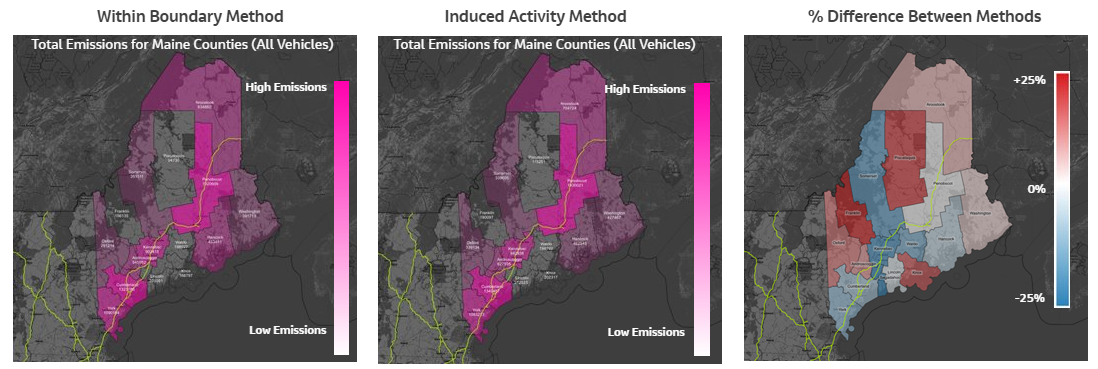
In the above example, StreetLight measures county-by-county emissions in Maine using these two different methodologies, and visualize the difference between the two methods in the map on the right. Looking at these methodologies side-by-side, several notable insights emerge:
Kennebec and Sagadahoc counties have lower emissions — 7% and 25% lower, respectively — when using the Induced Activity Method because they have more pass-through traffic on major highways that may be outside local county influence, but important to statewide planners.
Knox, Franklin, and Piscataquis counties have higher emissions — 21%, 22%, and 22% higher, respectively — when using the Induced Activity Method because they have a significant amount of VMT from transboundary trips that start or end in these counties.
Counties with a large positive change (red) are typically counties that are the origin or destination of long trans-county (EI or IE) trips because they:
Attract traffic from elsewhere in the region
Are home to communities that need to travel to other regions to access services or employment
And/or don’t have much passthrough traffic
Counties with a large negative change (blue) are typically counties that see a lot of passthrough traffic relative to total traffic. These are often counties with major highways.
These differences shed light on why different jurisdictions might want to understand baseline GHG according to these two methodologies, such as differing amounts of commuter traffic, induced demand, or highway traffic passing through the region. Whichever methodology an agency chooses for a given analysis, the ability to segment trips based on origin and destination data is key.
Zero in on Emissions Hotspots
Most emissions measurements are calculated at the regional level for an entire state, county, or city. But zeroing in on specific roads and even segments of roads can help pinpoint major sources of emissions that could be solved with targeted infrastructure or policy changes.
In the example below, we measure emissions at the road segment level for Marin County, CA, in the Bay Area, revealing an emissions hotspot on Richmond Bridge that is a major route between the East Bay and Marin County.
StreetLight’s GHG Emissions Metrics show segment-level emissions on highways in Marin County, CA. A high-emissions segment shows up in yellow on Richmond Bridge, revealing the emissions impact of this traffic bottleneck.
Emissions are lower on either side of the bridge, where vehicles can disperse, but as traffic becomes congested over the bridge, this segment generates an outsized impact on local emissions.
When agencies and consultants have access to segment-level insights like these, they can develop targeted mitigation strategies that supplement broader initiatives like electrification planning or active transportation projects. For Marin County, reducing congestion on Richmond Bridge could alleviate a significant contributor to jurisdictional emissions.
Measure Emissions Reduction from Electric Vehicles and Hybrid Vehicles
Encouraging the adoption of electric vehicles (EVs) and Plug-in Hybrid Electric Vehicles (PHEVs) is central to many national, state, and city decarbonization plans. Quantifying the total avoided tailpipe emissions from these vehicles can help agencies win funding and gain public support for electrification initiatives, giving them more traction and amplifying their impact.
StreetLight’s GHG Emissions Metrics allow agencies and consultants to view avoided tailpipe emissions based on VMT and market penetration rates for EVs and PHEVs in a given area.
In Maine, for example, StreetLight’s GHG Emissions Metrics show York, Cumberland, and Penobscot counties see the biggest reductions from EV penetration, most likely because they contain population centers such as Portland and Bangor. Cumberland County avoided 13,196 mt CO₂-eq in 2022 due to relatively high VMT and market penetration of EVs and plug-in electric hybrids (PHEVs). Penobscot County, on the other hand, had very similar VMT to York County (2.87B compared to 2.66B), but Penobscot avoided only 4,122 mt of CO₂-eq due to lower EV and PHEV penetration. Penobscot’s EV penetration rate is just a third of that in York County.
The advantages of electrification may seem obvious, but quantifying the positive impact of EVs and PHEVs over time can speed the path to net zero goals by making these advantages concrete and persuasive. Agencies can use these analyses to win federal funding for new charging stations or electric bus fleets, encourage the public to use EVs, or foster public-private partnerships with electric utilities and charging station manufacturers.
Measuring the impact of EVs over time is also key for public agencies to understand how far they’ve progressed toward decarbonization goals and course correct if the pace of change is falling behind.
Distinguish Between Personal Vehicle and Commercial Vehicle Emissions
Although light-duty cars and trucks account for 87% of all vehicle miles traveled in the U.S.,1 they contributed just 58% of the greenhouse gas emissions from transportation in 2021. By contrast, medium- and heavy-duty trucks accounted for 23% of GHG emissions, beating out aircraft, rail, and other forms of transportation and generating an outsized impact on atmospheric carbon levels.2
That means in order to accurately measure GHGs from local transportation, it’s important to understand how many vehicle miles traveled are generated by light-duty vehicles vs. medium- and heavy-duty vehicles. Likewise, segmenting GHG emissions by vehicle weight helps agencies identify where decarbonization strategies specifically targeting commercial vehicles — such as policies and programs that encourage private and public fleet electrification — may be impactful.
StreetLight’s GHG Emissions Metrics show the proportion of total emissions produced by light-, medium-, and heavy-duty vehicles for counties in Maine.
For example, in Maine, a county-by-county breakdown of emissions share by vehicle type reveals a few key insights:
Throughout Maine, light-duty traffic generates the bulk of emissions.
Somerset (13.7%), Penobscot (13.2%), and Androscoggin (12.5%) have the highest shares of emissions from heavy-duty traffic out of the 14 counties studied.
In Cumberland (9.6%) and Oxford (9.3%) counties, medium-duty vehicles contribute roughly 9% of total vehicle emissions, the highest rates among the 14 counties studied.
For more information on turning GHG measurements into effective decarbonization strategies, download our Transportation Climate Data Guide.
To learn more about StreetLight’s GHG Emissions Metrics, with regional and segment-level granularity, emissions avoided metrics, and personal vs. commercial vehicle impacts, check out our Transportation Climate Solutions.
1. Center for Sustainable Systems, University of Michigan. 2022. “Personal Transportation Factsheet.” Pub. No. CSS01-07. 2. United State Environmental Protection Agency. “Fast Facts on Transportation Greenhouse Gas Emissions.” June 13, 2023.
How to Measure Greenhouse Gas Emissions From Transportation
How to Measure Greenhouse Gas Emissions From Transportation
With transportation producing the lion’s share of carbon emissions, measuring greenhouse gases is a crucial step in fighting climate change, improving air quality, and protecting vulnerable communities. Here’s what you need to know to start measuring emissions now and power effective decarbonization initiatives.
Decarbonization is a hot topic (pun intended) in the transportation industry. As the impacts of climate change become increasingly evident, federal funding has also materialized for climate-friendly infrastructure projects. In the U.S., the Bipartisan Infrastructure Law (BIL) set aside grant funds for projects that help reduce emissions, increase sustainability, and improve resilience against climate change. Meanwhile, in Canada, the Net-Zero Emissions Accountability Act enshrines a commitment to achieving net zero emissions by 2050.
After all, transportation is the top source of greenhouse gas (GHG) emissions in the U.S., representing 27% of emissions in 2020, according to the EPA.
But even with funding available, reducing carbon emissions is no small feat. It relies on a variety of specialized efforts, from speeding EV adoption and building charging infrastructure to reducing overall Vehicle Miles Traveled (VMT) and encouraging active transportation modes. But all these emissions reduction strategies rely first on precise, ongoing measurement of GHG emissions across our transportation networks.
So how can we measure these emissions more accurately and pinpoint where they’re coming from? Even more importantly, how do measurements translate into climate-positive infrastructure and policy decisions? We explore each of these questions below.
How Are Greenhouse Gas Emissions Measured?
While the EPA measures and models GHG emissions from transportation, measurement has also become more common among local jurisdictions. Many cities, counties, states, and Metropolitan Planning Organizations (MPOs) have recognized the need to go beyond blunt GHG measurement based on national averages of metrics like speed and VMT as they seek to design and prioritize projects that will truly impact climate change as well as air quality.
These public agencies, often in partnership with AECs, are increasingly focused on the granular factors like vehicle type, dwell time, and localized VMT that help pinpoint significant sources of transportation emissions and identify areas with the worst air quality.
The question for many agencies is how to measure greenhouse gas emissions precisely in order to yield actionable insights. After all, it isn’t enough to know how high total GHG emissions are in your area, you need data that guides a concrete, likely multifaceted plan toward GHG reduction.
Because gas-powered vehicles release carbon dioxide and other emissions into the atmosphere when they burn fuel, it’s obvious that the more we drive, the more emissions we create. For this reason, measuring Vehicle Miles Traveled (VMT) or Annual Average Daily Traffic (AADT) can help establish an estimate of GHG emissions in an area and pinpoint areas of high traffic where mode shift initiatives or charging infrastructure may help lower emissions.
VMT is particularly relevant when measuring GHG emissions because longer trips create more emissions. Taking the average passenger vehicle emission rate of 404 grams of carbon dioxide per mile, estimating emissions from VMT is a simple matter of multiplication.[1]
Still, these metrics alone don’t tell the full story.
For example, they may not reveal how many vehicles on the road are electric vs. gas-powered, heavy-duty trucks vs. cars, or how much time each vehicle spends stuck in traffic. All these factors can impact the amount of CO2 a vehicle emits per mile traveled. To account for these factors, Vehicle Hours of Delay (VHD), trip speed, and trip duration may also be analyzed.
A sample StreetLight InSight® analysis shows Vehicle Hours of Delay (VHD) by time of day and day of week across multiple zones.
Likewise, the ability to segment traffic by vehicle type is crucial to a full-picture understanding of localized GHG emissions. Heavy-duty vehicles like commercial trucks — especially those that run on diesel — emit considerably more CO2 per mile traveled than light-duty vehicles like personal cars. The overall emissions produced by heavy-duty vehicles are also compounded by the fact that many of these vehicles are long-haul trucks, representing a large portion of total VMT due to the great distances they travel.
To put this into perspective, when the Environmental and Energy Study Institute (EESI) analyzed emissions from medium and heavy-duty vehicles in 2015, they found they represented only 5 percent of the vehicles on the road but accounted for over 20 percent of transportation emissions.[2]
StreetLight InSight® can be used to segment traffic by vehicle type and calculate VMT for light-, medium-, and heavy-duty vehicles separately.
In addition to segmenting traffic by vehicle weight class, a full picture view of emissions should also consider how many vehicles on the road are electric. New technologies like StreetLight’s EV Mode can also be used to identify how much of the total VMT can be attributed to all-electric vehicles, which produce no tailpipe emissions while traveling.
Origin-Destination (O-D) and Top Routes in an area may also be analyzed to help contextualize VMT measurements and guide emissions reduction strategies. For example, if O-D data reveals significant travel between locations that are just a few miles apart, this could signal a prime opportunity to add that cycling infrastructure like bike lanes in order to encourage mode shift and reduce overall VMT.
Case in Point: O-D Analysis Informs Regional Emissions Mitigation Strategies
When creating a GHG inventory for an area, considering O-D is especially important. While it’s often easier to simply count the total VMT traveled in a given area, this method does not account for pass-through trips which start and end outside of that area. This is a problem because communities that intersect major highways often appear to generate more emissions than they actually have control over.
Accounting for the origins and destinations of trips helps inform where to focus emissions reduction strategies. It also helps local communities avoid wasted investment in mitigation measures that may not actually impact the real sources of emissions as traffic passes through the area. Instead, transportation agencies can communicate with other regional stakeholders like state DOTs, MPOs, and port authorities to inform mitigation measures that actually address the source of traffic.
From measurement to reduction: how to use the data you collect
Of course, measuring VMT, VHD, trip speed, and other metrics is just one step in the decarbonization process. How can transportation leaders and practitioners use these metrics to inform emissions reduction projects?
For starters, it’s helpful to pair these metrics with other datapoints to yield precise measurements of GHG emissions, especially in cases where hard numbers are needed for regulatory compliance or air quality reporting. Other datapoints might include temperature and humidity, vehicle population (how many vehicles are in a given area), and vehicle age distribution (since older vehicles produce more emissions than newer ones).
A useful tool for accessing and interpreting these additional data sources is the EPA MOVES model. Their latest MOVES model, MOVES3, incorporates the latest data on vehicle populations, travel activity, and emission rates as well as updated fuel supply information at the county level. It also accounts for the increased emissions rate that occurs during “cold starts” (when a vehicle engine starts after a long period of disuse such as overnight) and long-haul truck trips.[3]
While the MOVES model helps account for additional factors, it’s worth noting that much of the data that goes into the model (such as average speed and VMT distribution) is taken from national averages and do not account for regional variation. That’s why we recommend pairing localized telematics data with models like these to get the full picture.
Once data has been gathered, effective emissions reduction projects usually address specific roadways where total VMT and congestion metrics like VHD are high. To reduce VMT and VHD, transportation professionals may prioritize improvements to the public transit system, add bike lanes, or address barriers to pedestrian safety such as a lack of sidewalk access or signalized crossings. Likewise, high-traffic roadways and top origins or destinations in a region may be identified as prime locations for charging infrastructure in order to speed EV adoption.
Because the most effective decarbonization strategies are multifaceted, communication with other local agencies, utilities providers, policymakers, and the public is key.
For example, the Twin Cities Metropolitan Council used StreetLight data to develop an online tool to share emissions data with local governments. This way, individual jurisdictions and townships could easily access publicly available data on local emissions rather than relying on national averages alone. Along the way, they used O-D analyses to solve over-counted emissions for small communities that intersected major highways, helping to clarify where emissions reduction projects would be most impactful.
For more information on turning GHG measurements into effective decarbonization strategies, download our Transportation Climate Data Guide.
United States Environmental Protection Agency. “Greenhouse Gas Emissions from a Typical Passenger Vehicle.” June 30, 2022.
Environmental and Energy Study Institute. “Fact Sheet | Vehicle Efficiency and Emissions Standards.” August 26, 2015.
United States Environmental Protection Agency. “Latest Version of MOtor Vehicle Emission Simulator (MOVES).” December 9, 2022.
Start reducing greenhouse gas emissions in your area
Explore the resources listed above and don’t hesitate to reach out if you have any questions. We’re committed to fostering a collaborative community of transportation professionals dedicated to building a better future for our cities and communities.
EVs, Decarbonization, & Equity Are Front-and-Center At TRB 2023
EVs, Decarbonization, & Equity Are Front-and-Center At TRB 2023
This year’s Transportation Research Board (TRB) was the first gathering since funds began rolling out in earnest from the Bipartisan Infrastructure Law (BIL). With the pandemic disruption to travel patterns and BIL funding in the background, conference attendees and panel sessions kept coming back to key themes throughout the conference — decarbonization and equity.
As Secretary Buttigieg said in his keynote address,
“Research and innovation will play an exceptionally important role in the decade ahead for transportation.”
But he and others were quick to acknowledge that the challenges transportation professionals faced were in many ways bigger than ever.
While panels and posters covered myriad topics, key themes emerged that will shape the year ahead in transportation planning and research.
We dive into the big topics in our TRB recap webinar. Watch it here.
It’s not about getting people from A to B as fast as possible anymore
It’s hard to say when it happened but there is no question that the transportation industry’s role has expanded. Questions of land use, economic development, safety, resilience, and climate impact all intersect with the transportation industry and must now be considered in tandem with any planning decisions.
As such the way we study our roadways and corridors is completely different from how it used to be — it’s no longer about counting cars at intersections during rush hour. Now we need to take an expansive look at the comprehensive uses and needs of the people using our networks. Even studying who is not using these roadways and why — raising questions of equity and segregation — are central to transportation decisions.
On the one hand, the data available to enact this work has never been more plentiful. But it also requires coming to thorny transportation questions with a set of hypotheses, and being willing to challenge those hypotheses with empirical evidence.
Transportation planners no longer have to work based on a set of assumptions about when people travel and why. Nor could they, given the way the pandemic has utterly disrupted travel patterns. But this also means that they are faced with many ways of looking at a problem. Significant analytical skills will be needed, and even a dose of humility, to ensure that agencies are identifying the biggest problem and then right-sizing the solution to that problem.
Decarbonization is not a buzz word
The centrality of decarbonization was threaded throughout much of TRB. We’ve heard it many times by now — transportation is the single biggest contributor to greenhouse gas emissions. Now BIL funding has put EVs front-and-center as the lever that could help pull transportation emissions downward by putting significant resources behind charger installation. In addition, more incentives for EV purchases could further speed adoption.
To that end, StreetLight’s introduction of EV mode at the conference can help agencies learn and adapt to how EV driver behavior may differ from gas-powered driver behavior, whether current EV chargers are being installed where they’re needed, and whether there are gaps in how roadway networks support EV drivers.
Transportation professionals have other means of pursuing decarbonization beyond facilitating the EV transition, especially by investing in multimodal infrastructure. Here the subject of coordination across local and regional agencies came up often — and remembering that safety, in all its forms, is the most important responsibility of transportation agencies — not speed.
Equity must be threaded into every aspect of transportation
From procurement to infrastructure investment, equity is not a second order function for transportation professionals. As agencies look to unlock infrastructure funding, it’s clear that the equity impact will be central to the success of grant applicants. Data will be essential to making that case for how investments support equity goals, or redress long-standing disparities.
Agencies are tasked with “gathering the data to make the case on ways for transportation policy to be a powerful tool in the service of fairness and equity,” said Secretary Buttigieg.